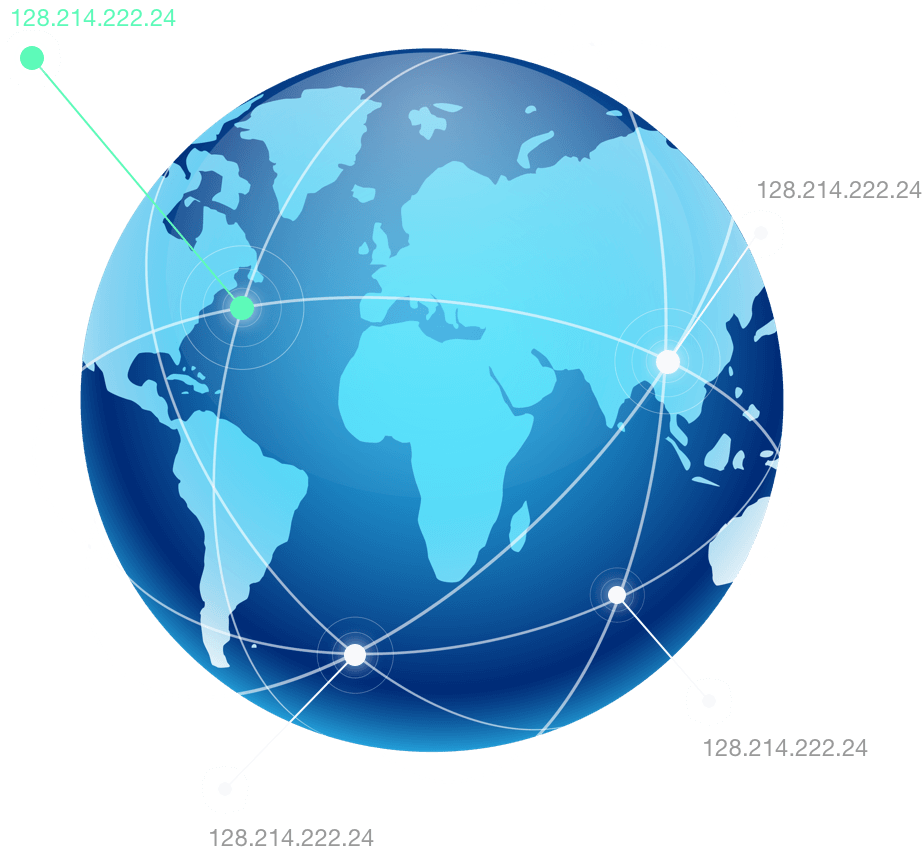
Identify the user’s location at the time of access from the country down to the city or postal code level.
Our bulk IP address lookup tool gives you a web users’ latitude and longitude coordinates.
Find out the corresponding time zone (UTC) behind a web user’s given location.
Find out the GeoNames identifier of a user location.
Learn who the Internet service provider (ISP) in charge of a given IP address is.
Check Autonomous System (AS) numbers, IP blocks, and connection types (cable/digital subscriber line [DSL], content, educational/research, etc.) of particular IP addresses.
Get a list of resolving domain names with our bulk IP checker.
Identify the kind of Internet connection (mobile, broadband, etc.) a visitor uses.
A bulk IP lookup, also known as a batch IP lookup, is a type of query done to check the location, ISP, AS details, linked domains, Internet connection, time zone, and other data points of a large number of IP addresses simultaneously.
Harness the power of geo-targeting by catering to the right audiences aided by a robust IP lookup tool. Locate your best markets and tailor your marketing campaigns and strategies to them.
Improve the performance of security solutions and systems by adding IP geolocation data to your threat intelligence sources. Pinpoint known threat sources and block them at the IP level if you have to before they can cause damage.
Personalize website content to keep visitors coming back for more. Customize product or service recommendations; cater to customers’ preferred languages, currencies, and payment methods; and more with our bulk IP checker.
Prevent transaction fraud and content theft in real-time. Comparing subscribers’ current locations, identified through a bulk IP lookup, with their geolocation data on record can help you catch impostors.
Enrich your traffic logs and monitoring systems with IP location data to meet regulatory requirements and prevent transactions with designated countries.
IP geolocation points to the nearest-known physical location where a specific user currently is based on its IP address. Subjecting an IP address to an IP geolocation lookup provides a user’s country, region, city, latitude and longitude coordinates, time zone, GeoNames ID, AS details (AS number, ISP, route, domain, and type), and Internet connection type, among other data points.
Organizations typically keep track of both incoming and outgoing network traffic. And that translates to hundreds or even thousands of domains and IP addresses per day. Checking them out one by one may be time-consuming and prone to human error. That’s what makes batch IP lookups convenient.
Bulk IP lookups are helpful to any organization that wants to keep track of website visitors and users. They are also useful for those who want to prevent fraud, comply with strict area-specific requirements, and keep malicious IP addresses out of their networks. They can also be valuable to advertisers who rely on geo-targeting and geofencing.
Bulk IP Geolocation GUI works similar to our IP geolocation lookup tool. Unlike the latter, though, our bulk IP lookup tool can take as many as 100,000 IP addresses as input per query. You can either copy and paste the data into the input field or upload a comma-separated values (CSV) file to the tool and get the results in CSV format after in minutes.
Our IP geolocation data gets updated daily. That means you get the latest location information available every day, which can be particularly important when you’re investigating specific IP addresses. Since ISPs have a limited number of IP addresses, and these typically are assigned based on availability, users’ IP addresses can change from time to time. As a result, they can get any of the providers’ unused IP addresses at the time they’re accessing the Internet. Therefore, having up-to-date information regarding a particular IP address can be crucial.
“ We’ve used WhoisXML API’s data in our own investigations, and it is one of the most popular integrations among Malfors users. It is the best source we’ve found for WHOIS data, including WHOIS history and Reverse WHOIS. Analysts can pivot on DNS records or WHOIS text to uncover more infrastructure and support threat actor attribution. Our users, from SOC teams to incident responders, can access that data in just a few clicks. ”
“We want to provide all Cyberscape users the ability to integrate relevant data for their cyber threat investigations. WhoisXML API provides unique data that will be helpful to the cyber threat investigation community, allowing analysts to shorten the cycle of understanding and mitigating threats.”
“WhoisXML API builds out data sets that help users correlate attack infrastructure with related IP and WHOIS information.”


Find domains and subdomains related by specific terms in their hostnames.
Learn more
Get insights for the new business registered on the web.
Learn more
Monitor exact matches, variations and common misspellings of your brand name & trademarks.
Learn more
Get the most relevant data to be ahead of emerging security threats.
Learn more
Track domains registered in coordinated batches, complete with WHOIS and DNS details for every domain.
Learn more
We provide complete and relevant domain WHOIS data which can be customized and easily integrated as per your business needs.
Learn more
Assess the domain's or IP addresses reputation and risk profile with a simple score based on a comprehensive...
Learn more
Get the most comprehensive database of SSL (Secure Sockets Layer) Certificates.
Learn more
Find out the exact physical location of any IP address, email or domain name.
Learn more
Enhance your domain research toolkit by our enterprise-grade web-based solution that helps you in searching...
Learn more
Give the list of domain names tied to the specified DNS records via API calls with outputs in JSON and XML.
Learn more
Get data feeds of SSL certificates along with their well parsed fields in real time. Accurate. Up-to-date.
Learn more
Easily identify malicious resources and retrieve their threat information.
Learn more
Get well-parsed and normalized WHOIS information for any domain name, IP address or email.
Learn more
Get data feeds of new registered domains along with their WHOIS data generated in real time.
Learn more
Find out which domains were added or dropped by registrants, with given search criteria.
Learn more