Find out detailed IP geo data, including the postal code, city, region, ISO 3166 two-letter country code, and country.
Get the latitude and longitude coordinates of IP addresses of interest.
Find out what time zone matches the IP address’s location in “+10:00” format (UTC).
Gather IP addresses’ location identifiers as per the GeoNames database.
Learn which Internet service provider (ISP) is responsible for a particular IP address.
The domain name, Autonomous System (AS) number, and route taken are all relevant identifiers of the network behind an IP address and are included in our IP geolocation database.
Find out what kind of network the IP address uses—cable, digital subscriber line (DSL), ISP, etc. Know what it’s used for, too (content, educational/research, enterprise).
Check the list of domain names connected to an IP address.
Check IP addresses’ connection types (modem, mobile, broadband, or company).
Use a given IP address, domain name, or email address to track the exact location of an IP address, including latitude and longitude, time zone, country, region, city, postal code, ISP, AS number and organization, connection type, domain name, and more.
Accurately identify your users’ geographical location with a large number of geolocation attributes through just one API call.
We provide a bulk IP tracker geolocation service available online or through API access. Upon registration, you will get 1,000 free IP/email/domain ID checks. Upload your existing data and download the results.
All of our IP geolocation data is available for purchase via downloadable feeds in comma-separated values (CSV) or JavaScript Object Notation (JSON) format.
More than just IP geolocation. Geospatial IP data enables high-confidence fraud detection, smarter risk scoring, and new security workflows with precision and coverage that traditional IP geolocation never could support.
Know the way IP addresses are allocated among countries, ISPs, and other physical locations.
View statistics
We aim to offer the best IP geolocation services. All of our products support IPv4 and IPv6 addresses and provide data on circa 99.5% of all IP addresses in use today.
We add or update hundreds of thousands of records to our IP geolocation database weekly. Our efforts are supported by legal agreements with the world’s largest ISPs.
We strive to widen our database’s reach while increasing its IP geolocation accuracy. Our data is consistently formatted for immediate use or easy integration into existing platforms.
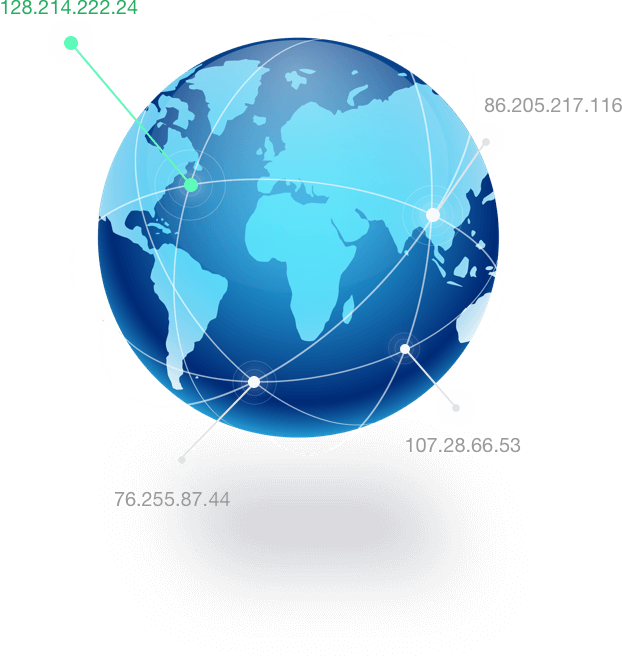
IP geolocation is the process of identifying the approximate location (such as country, city, or approximate latitude/longitude) of a device (laptop, phone, server, etc.) based on its IP address. It helps identify where internet users or servers are connecting from, often used for content customization, market research, security, or compliance.
IP geolocation works by mapping IP addresses to geographic locations using large geolocation databases compiled from various sources. These sources include:
The result is an approximate location—often down to the city level—but accuracy can vary depending on the IP type and the methods used.
To identify geolocation for a domain, we run a DNS lookup to identify its associated IP address, and then we run IP geolocation for that address.
For email addresses, we first discover the mail server that this email uses based on the MX record of the domain in the email. Then, we run a DNS lookup for that server to get its IP, and then, we can geolocate it.
No, IP geolocation does not identify a precise location like a street address. It typically estimates a general area—such as a city or region—and its accuracy depends on factors like the type of IP address (static vs. dynamic), ISP data, proxy usage, VPNs, etc.
No, it’s not. IP address geolocation often reveals the location of the website user’s internet service provider (ISP), which has allocated the IP address the user is using.
This means that it can offer city-level precision, but not down to the street level. It doesn't reveal any personally identifiable information, meaning that when a website is using IP geolocation, it doesn’t create privacy concerns for the website users. It also means that using IP geolocation doesn’t require any explicit permission from the user.
WhoisXML API provides accurate IP geolocation data, with the location accuracy being limited by the fact that IP geolocation doesn’t offer street-level accuracy by design.
The accuracy of IP geolocation data is sufficient for geotargeting or geofencing, as well as for cybersecurity purposes and market research.
There are applications of IP geolocation data across very different industries and use cases. Here are some examples:
These are just a few example use cases. Almost every industry has its own use case for IP location data.
“We want to provide all Cyberscape users the ability to integrate relevant data for their cyber threat investigations. WhoisXML API provides unique data that will be helpful to the cyber threat investigation community, allowing analysts to shorten the cycle of understanding and mitigating threats.”
“WhoisXML API builds out data sets that help users correlate attack infrastructure with related IP and WHOIS information.”


Find out which domains were added or dropped by registrants, with given search criteria.
Learn more
Easily detect all typosquatting domain names as soon as they are registered each day.
Learn more
Find domains and subdomains related by specific terms in their hostnames.
Learn more
Get data feeds of new registered domains along with their WHOIS data generated in real time.
Learn more
Get well-parsed and normalized WHOIS information for any domain name, IP address or email.
Learn more
Assess the domain's or IP addresses reputation and risk profile with a simple score based on a comprehensive...
Learn more
Enhance your domain research toolkit by our enterprise-grade web-based solution that helps you in searching...
Learn more
We provide complete and relevant domain WHOIS data which can be customized and easily integrated as per your business needs.
Learn more
Monitor exact matches, variations and common misspellings of your brand name & trademarks.
Learn more
Get the most relevant data to be ahead of emerging security threats.
Learn more
Find out the exact physical location of any IP address, email or domain name.
Learn more
Get data feeds of SSL certificates along with their well parsed fields in real time. Accurate. Up-to-date.
Learn more
Give the list of domain names tied to the specified DNS records via API calls with outputs in JSON and XML.
Learn more
Easily identify malicious resources and retrieve their threat information.
Learn more
Get the most comprehensive database of SSL (Secure Sockets Layer) Certificates.
Learn more
Get insights for the new business registered on the web.
Learn more